1 kilometer = 0.621371 miles, and 1 mile = 1.609344 kilometers, exactly. Type a distance and the answer shows up as you type, in either direction, along with miles and yards, a pace calculator and a list mode for whole training logs.
- 1 km = 0.621371 miMultiply kilometers by this number
- 1 mi = 1.609344 kmExact, by international agreement
- 5 km ≈ 3.1 miA 5K race
- 42.195 km ≈ 26.2 miA full marathon
Quick Start: Convert Kilometers to Miles in 3 Steps
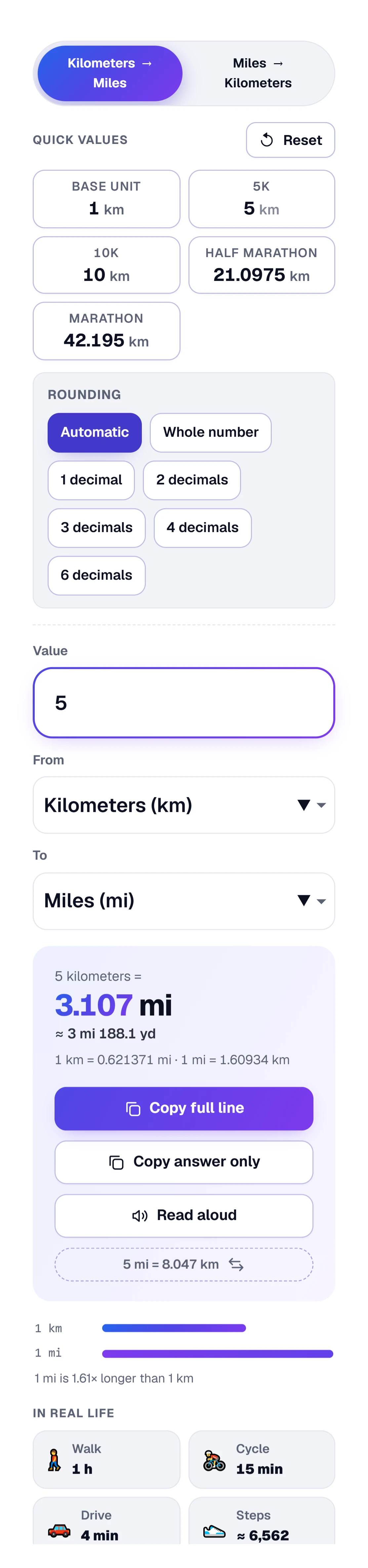
Each part of the converter has a small number in the picture below, and the steps in this guide use the same numbers.
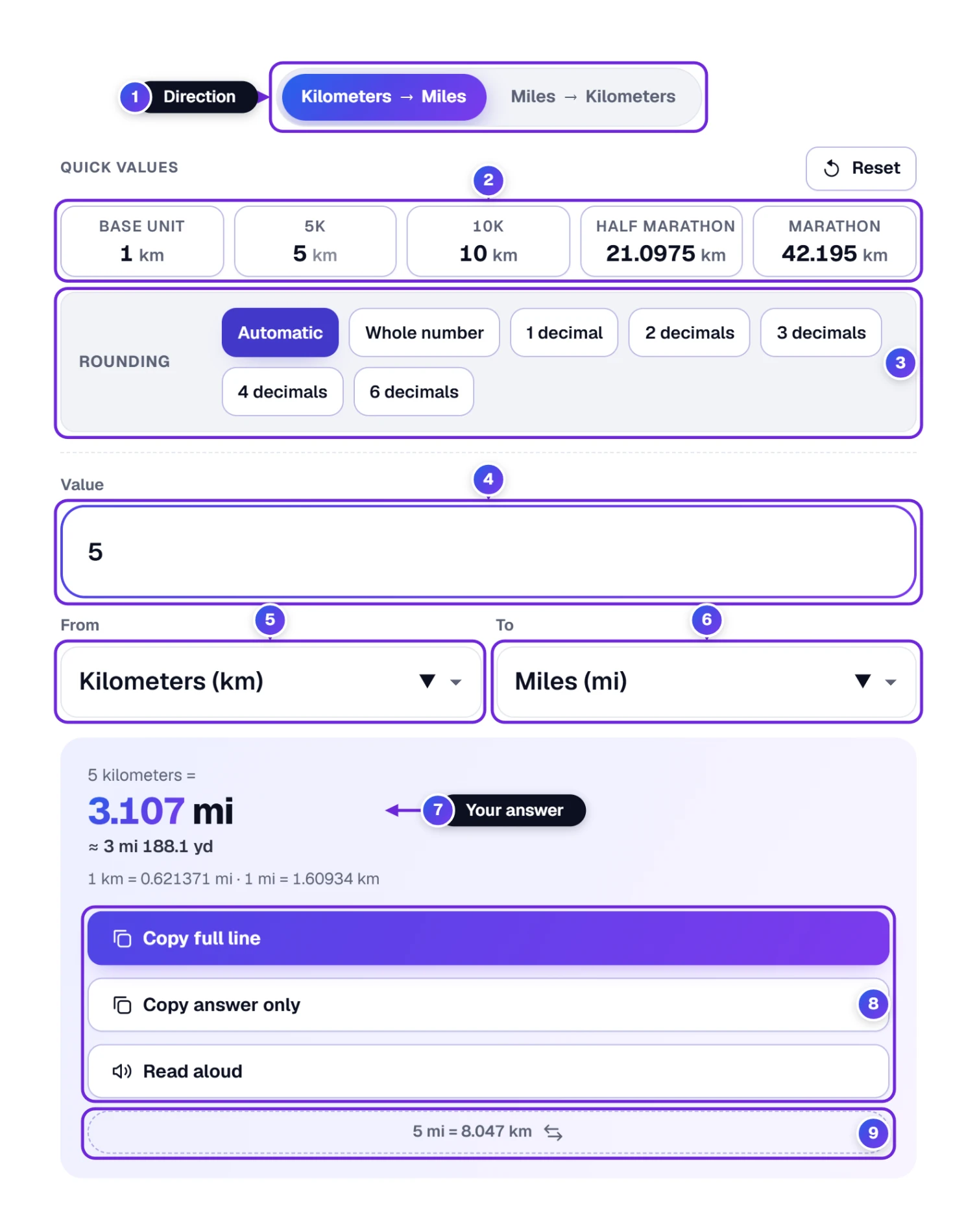
- Type your number into the Value box 4. Or skip the typing and pick a ready-made distance 2, like 5K or Marathon.
- Look at the direction 1. The page opens on Kilometers → Miles. If your distance is in miles, tap Miles → Kilometers instead.
- Read your answer 7. Copy answer only keeps just the number, Copy full line keeps the whole sentence, and Read aloud speaks it 8.
For most people, those three steps are the whole job. The sections below cover the other parts: the direction switch 1 and the race-distance buttons, the Rounding choices 3 with Reset, the From 5 and To 6 lists with the swap button between them, and the button that shows the same number the other way 9.
Switch Direction and Use the Race-Distance Buttons
Two buttons at the top decide whether you start from kilometers or from miles. The quick values below them change with the direction. Each one has a name and a distance, so you can tell a 5K from a half marathon at a glance.
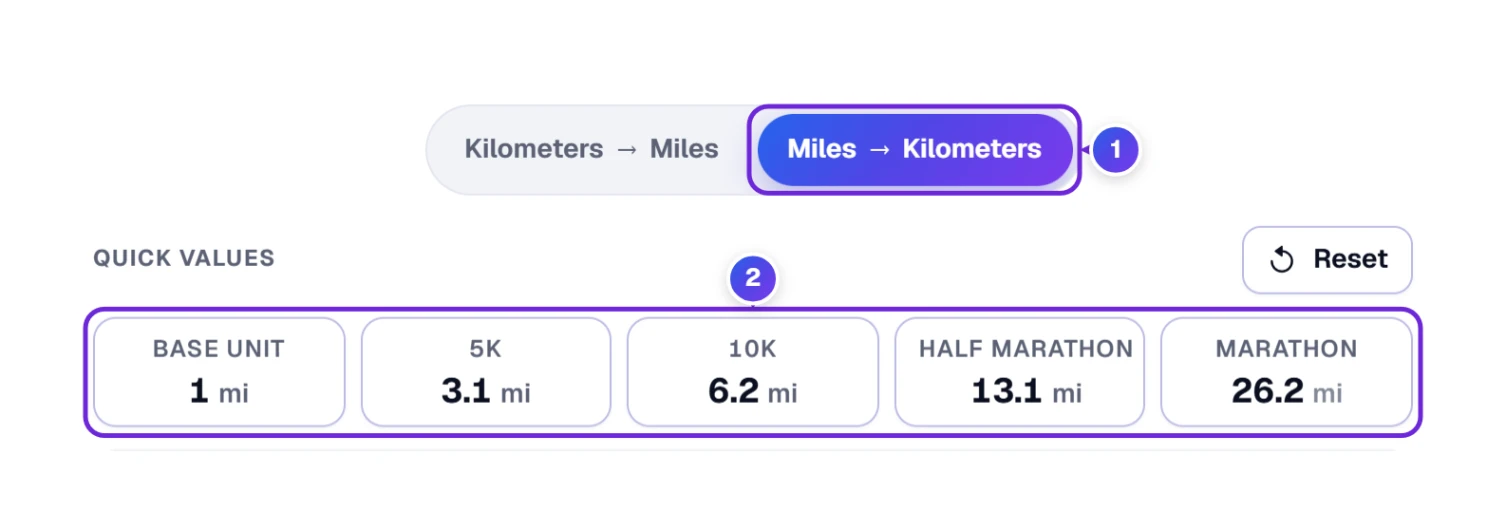
- Tap Miles → Kilometers 1 when your starting number is in miles. Kilometers → Miles brings you back.
- Pick a tile 2. Each one carries a name and a distance. Base Unit is 1 kilometer (or 1 mile); then come 5K, 10K, Half marathon and Marathon. In miles they are 3.1, 6.2, 13.1 and 26.2 mi; in kilometers they are 5 km, 10 km, 21.0975 km and 42.195 km. “5K” and “10K” are the names of popular running races; point at a tile to see it spelled out.
The swap button between From and To does the same as the direction buttons. On a computer you can also press S.
Round the Answer to Whole Miles or More Decimals
A road sign wants whole miles, while a school sum may want six decimals. The Rounding choices under the quick values let you pick how much of the answer you see.
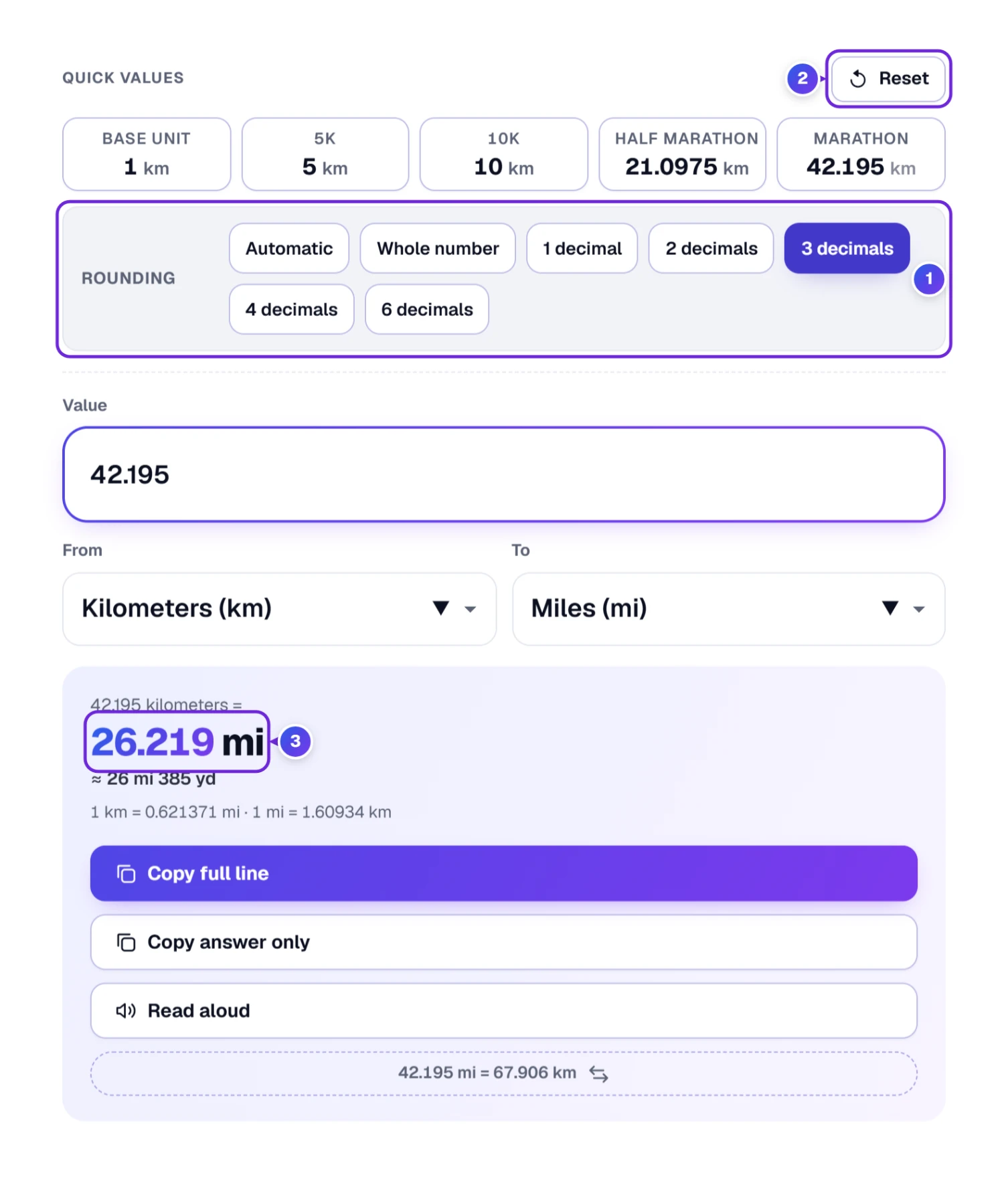
- Find Rounding 1. Automatic is selected when the page opens.
- Tap the choice you want: Whole number, 1 decimal, 2 decimals, 3 decimals, 4 decimals or 6 decimals. The answer 3 changes at once. For a marathon, 42.195 km, you get 26 mi, 26.2 mi, 26.22 mi, 26.219 mi, 26.2188 mi and 26.218757 mi.
- Automatic picks a sensible number of decimals for the size of your number: 1 km shows 0.6214 mi, and 42.195 km shows 26.22 mi.
- Press Reset 2 to start again with 1 kilometer to miles and Automatic rounding.
Rounding changes only the big answer. The miles and yards line under it stays exact, so 42.195 km still reads 26 mi 385 yd whichever choice you make.
Read Your Answer: Miles, Miles and Yards, and Both Factors
Your answer updates while you type. Under it you get extra lines that make the number easier to use.
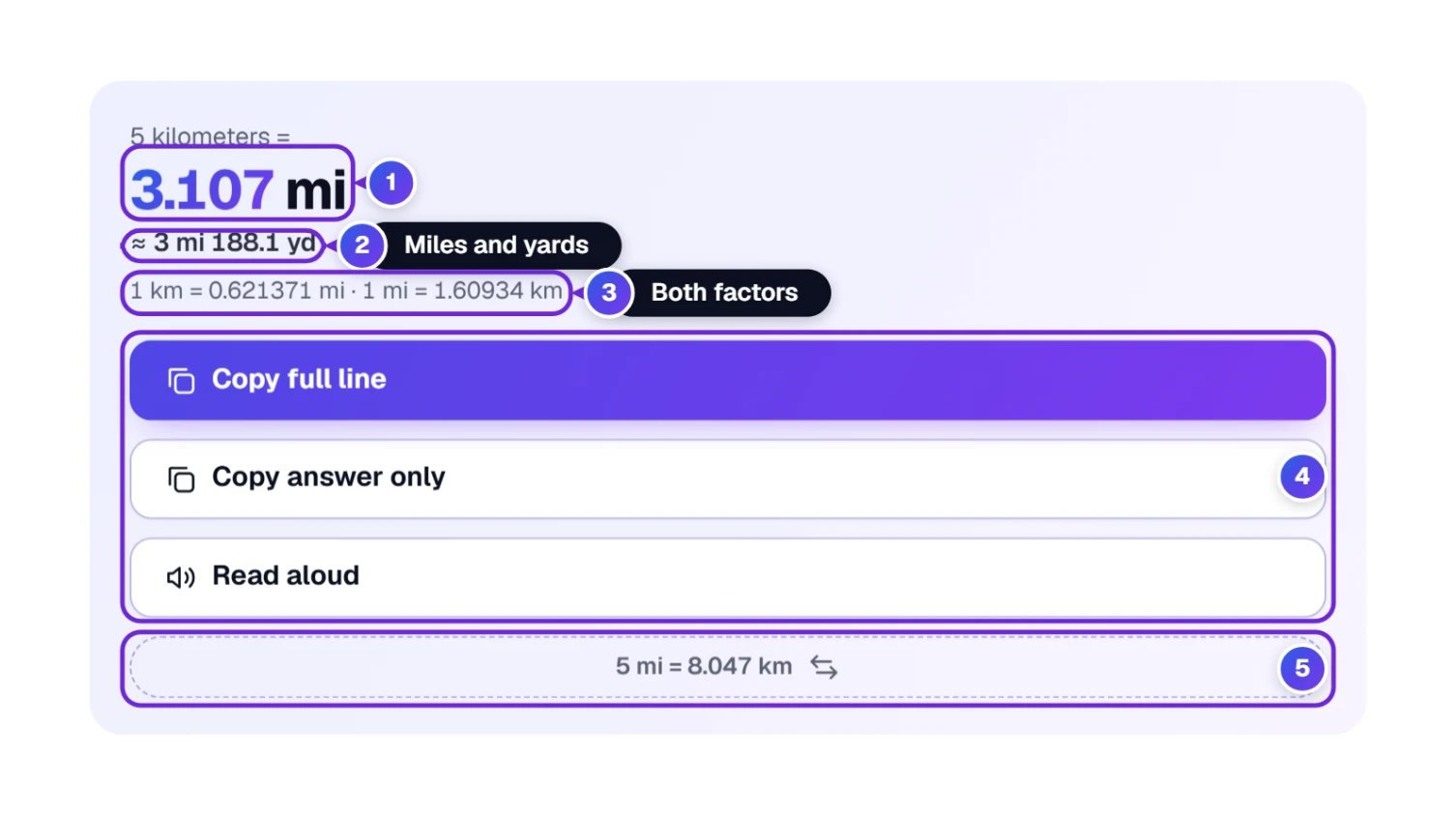
- The answer 1 in large type, for example 3.107 mi for 5 km.
- Miles and yards 2: the same distance as whole miles plus yards: 5 km ≈ 3 mi 188.1 yd. Under 1 mile you get yards only: 1 km ≈ 1,093.6 yd.
- Both factors 3: 1 km = 0.621371 mi and 1 mi = 1.60934 km, so you can check any number yourself.
- Copy full line, Copy answer only and Read aloud 4: the first sends the whole sentence (“5 km = 3.107 mi”) to a chat or a document, the second takes only the figure (“3.107 mi”). The third speaks the result, for example “5 kilometers is 3.107 miles”, and a second press stops it.
- The other way 5 shows your number in the opposite direction (5 mi = 8.047 km). Click it to swap.
A lap of a standard running track is 400 meters. Type 0.4 and you get 0.2485 mi, or about 437.4 yd, just short of a quarter mile (440 yd).
See How Far It Really Is
A number alone does not tell you much. The bars and the In real life row turn it into something you can picture.
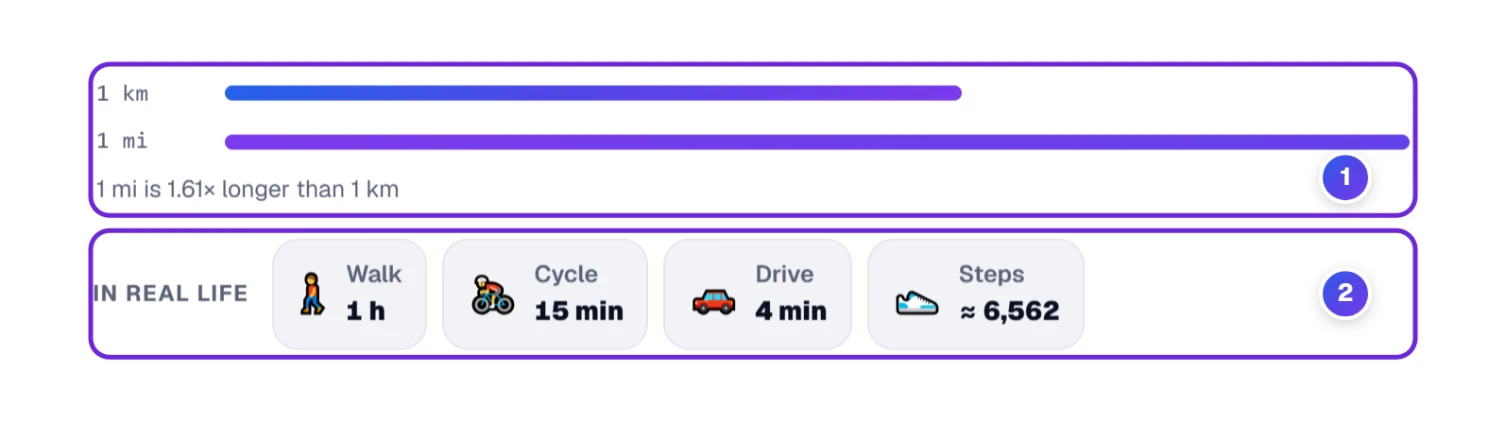
- The bars 1 compare one kilometer with one mile: a mile is about 1.61 times as long.
- In real life 2 shows roughly how long the distance takes on foot (5 km/h, about 3.1 mph), by bike (20 km/h, about 12.4 mph) and by car (80 km/h, about 50 mph), and about how many steps it is (a step of 0.762 m, or 2.5 ft). For 5 km that is about 1 hour of walking, 15 minutes on a bike, 4 minutes in a car and about 6,562 steps.
These are typical averages, not your own pace. Point at the row to see the numbers behind them.
Check the Math With Explain This Result
Checking homework, or double-checking a race distance? The converter shows every step of the calculation.
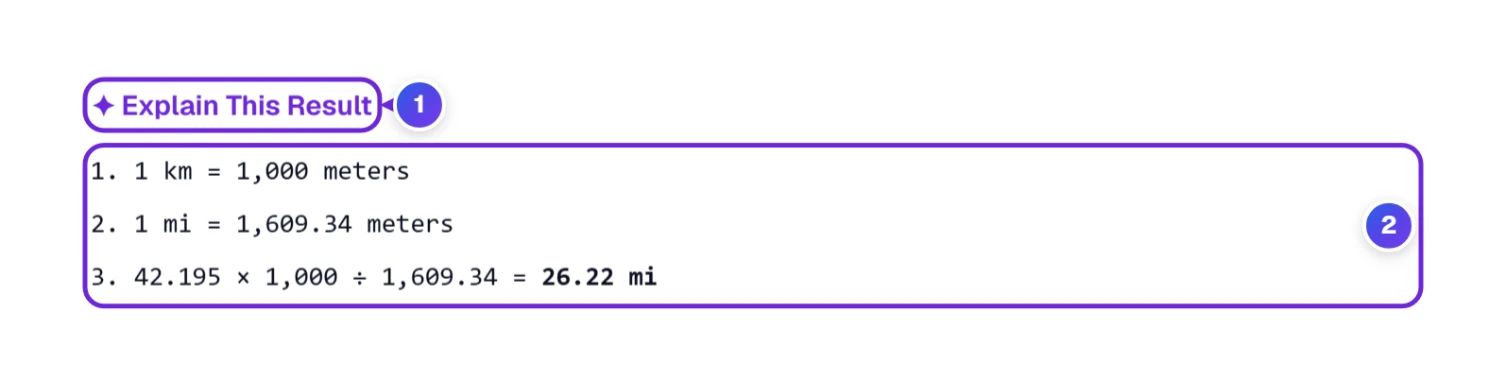
- Open ✦ Explain this result 1, the folded line below the converter.
- Follow the steps 2: 1 km = 1,000 meters, 1 mi = 1,609.34 meters, and 42.195 × 1,000 ÷ 1,609.34 = 26.22 mi.
- Type a different distance and the working redraws itself.
Build a KM-to-Miles Chart for a Training Plan
Need a list for a training plan, a class or a spreadsheet? The converter builds a table for the units you picked, from 1 to 1,000 plus your own number.
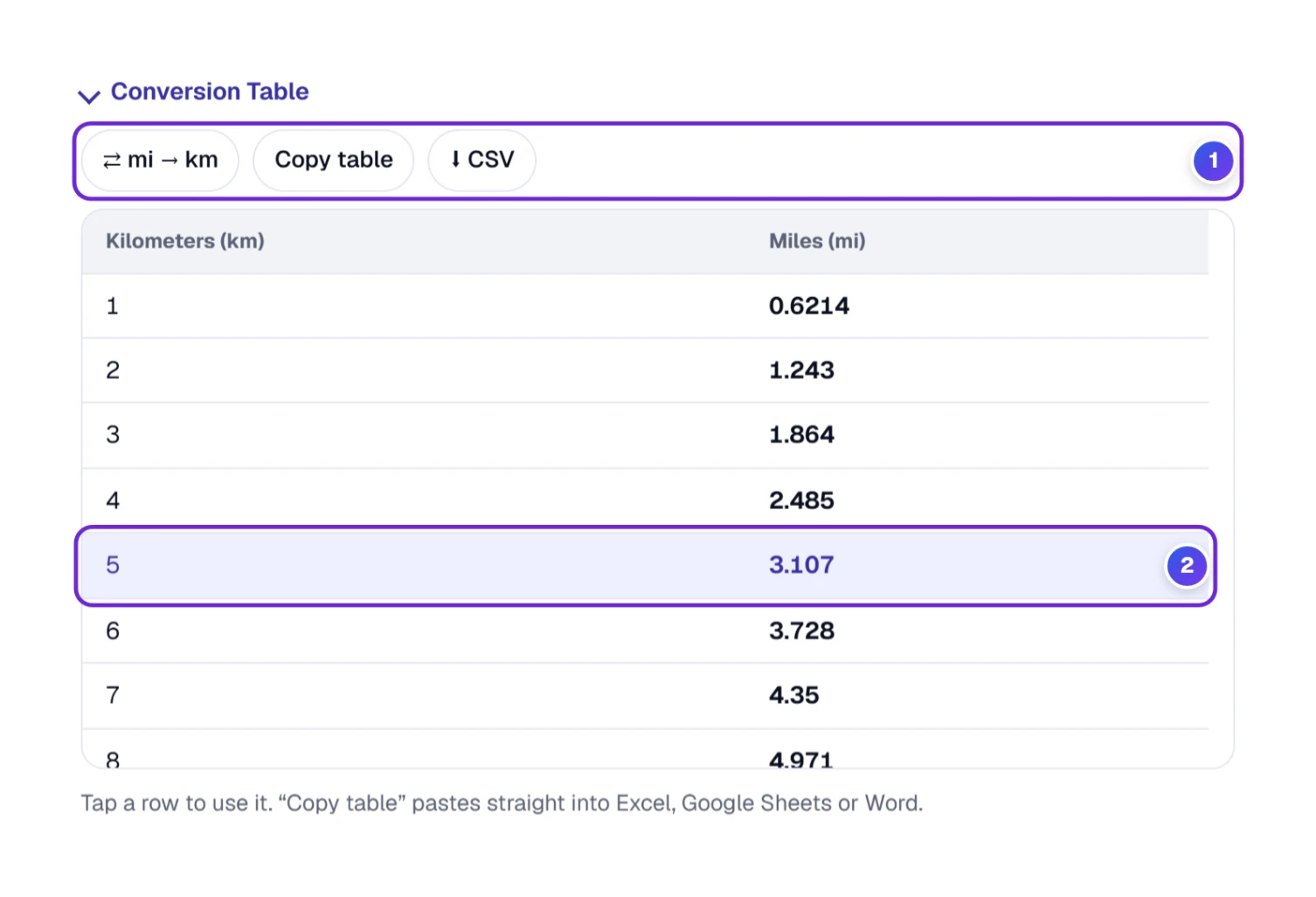
- Open Conversion table under the tool. On a keyboard, T does the same.
- Your own number is added and highlighted 2, here 5 km = 3.107 mi.
- The buttons on top 1 do three jobs: ⇄ mi → km puts miles in the first column, Copy table lifts every row for a spreadsheet cell or a document, and ⬇ CSV downloads a file.
- Tap a row and the converter jumps to that distance.
Paste Race Splits or a Training Log
Got a column of numbers, such as race splits, a week of runs or distances from a spreadsheet? Paste them all and get every answer in one go.
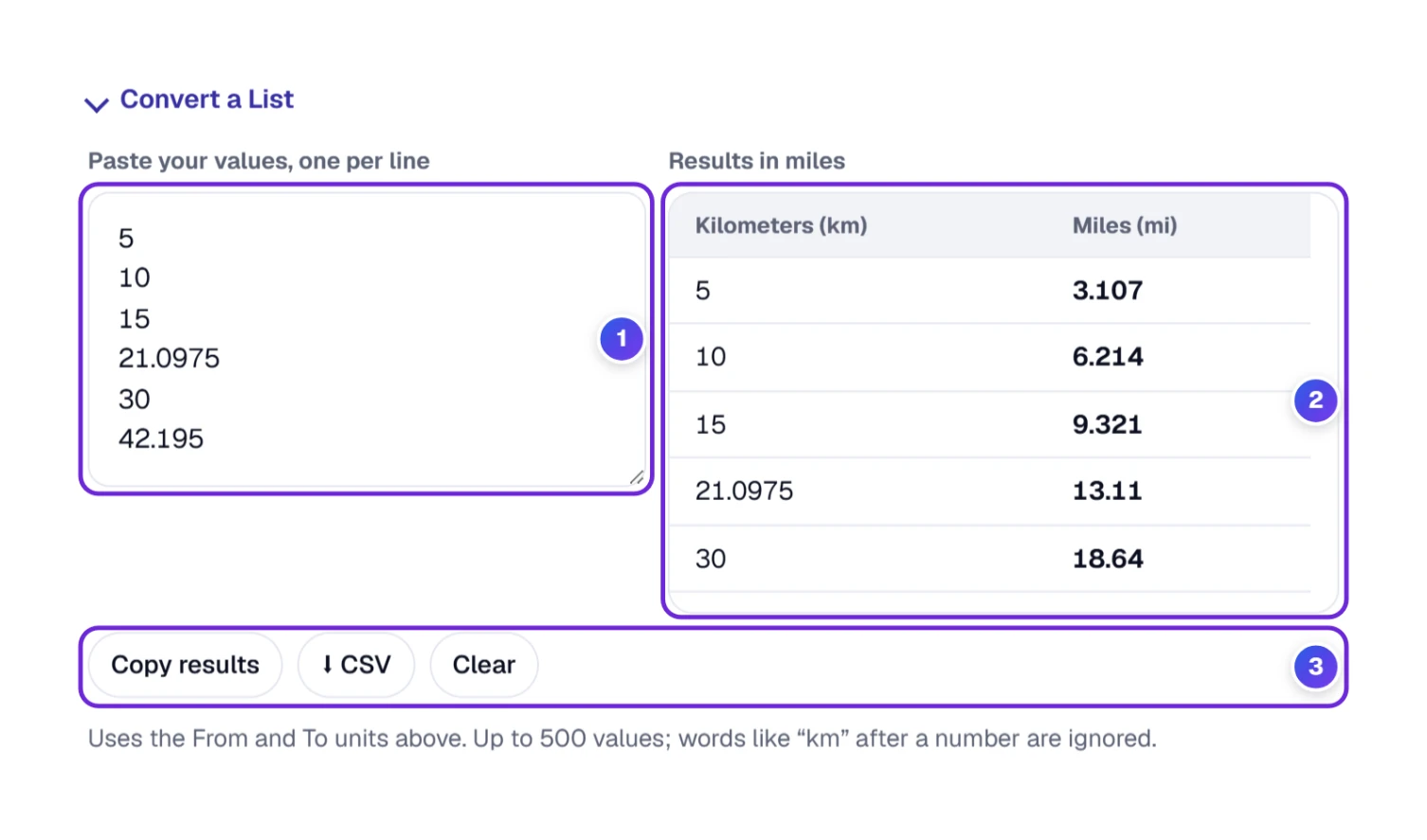
- Open Convert a list (keyboard: L).
- Paste your distances 1, one on each line. Separators like commas, semicolons or tabs are fine, and “10 km” is read as 10. A number such as 1,234 stays whole.
- Each answer 2 lines up with its value, in the From and To units set above. A line without a number is marked not a number and left out.
- Copy results 3 takes both columns to a spreadsheet, ⬇ CSV downloads them, and Clear empties it again. The limit is 500 values.
Have a list in miles? Tap Miles → Kilometers first; the list follows the direction.
Something we noticed while testing: a comma splits a line in two. We pasted “5,5” expecting 5.5 km and got two rows of 5 km each. Thousands such as 1,234 stay one number, but for decimals you need a dot.
See Your Distance in Every Length Unit
Sometimes you need the same distance in feet or meters as well. One click shows them all.
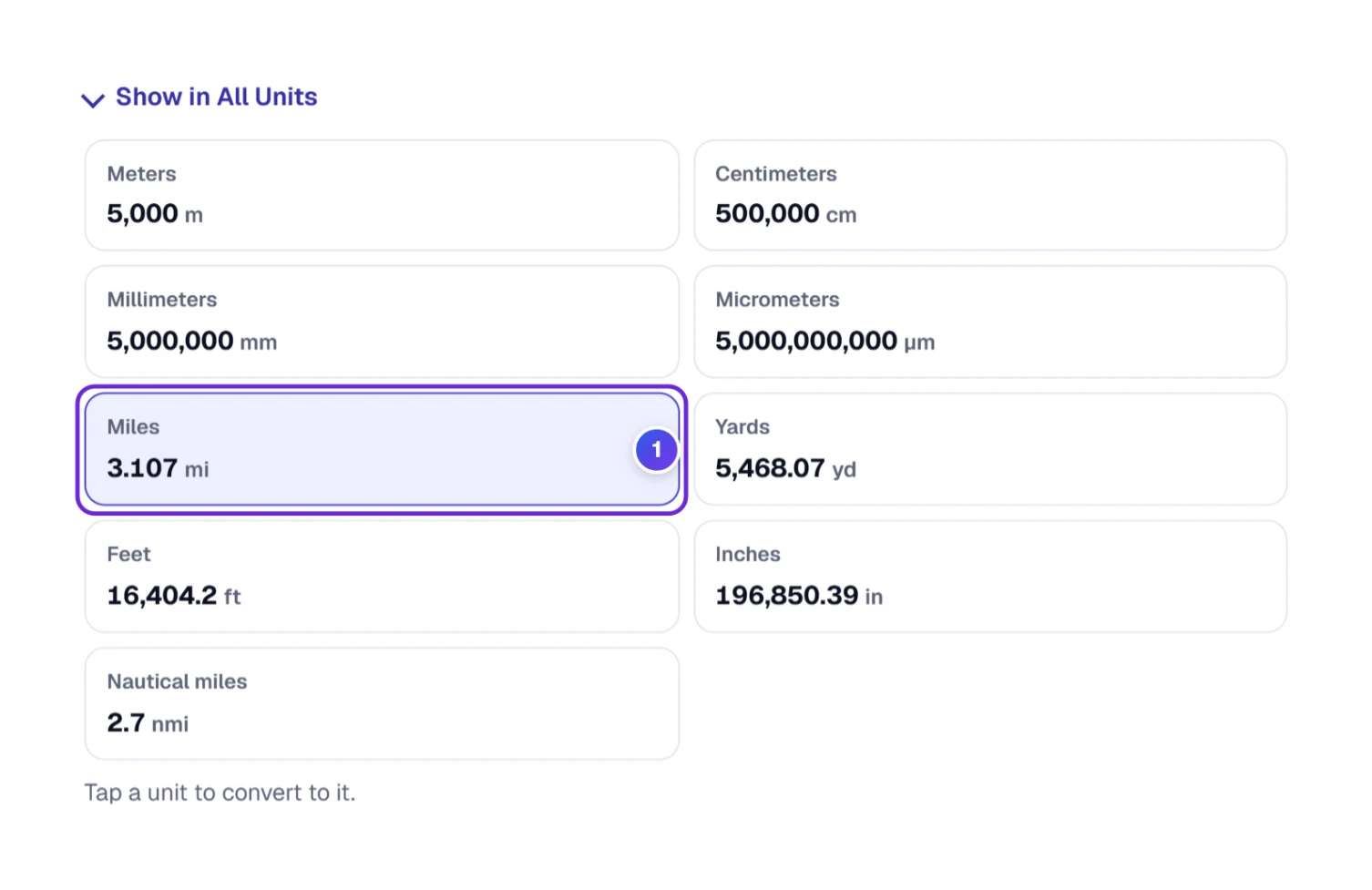
- Click Show in all units under the tool.
- You see your distance in meters, centimeters, millimeters, micrometers, miles, yards, feet, inches and nautical miles.
- Tap a unit 1 to make it the To unit. You can also pick any unit in the From and To lists at the top.
Work Out Your Running Pace
Ran a race in kilometers but think in minutes per mile? Enter the distance and your time.
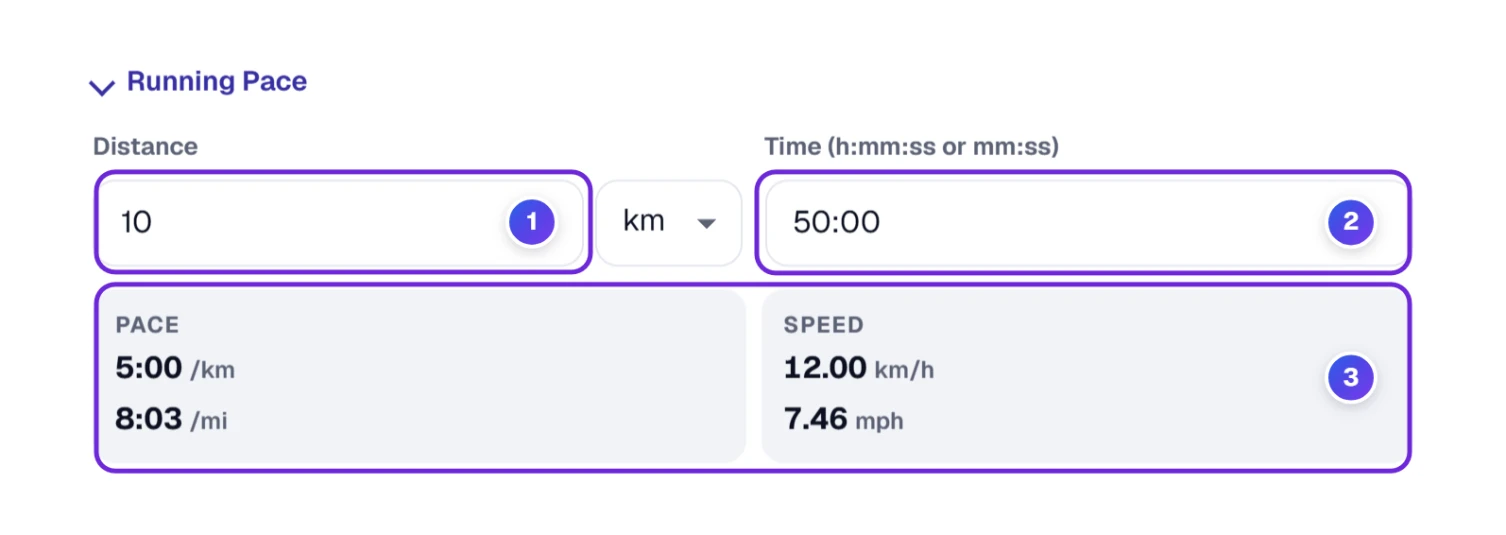
- Click Running pace under the tool.
- Enter the Distance 1 and pick km or mi.
- Enter your Time 2 as h:mm:ss or mm:ss, for example 50:00.
- Read your Pace and Speed 3: 10 km in 50:00 is 5:00 per km, 8:03 per mile, 12 km/h or 7.46 mph.
Go Back to a Distance You Converted Earlier
Every conversion you make goes into a short history on this device, so yesterday’s 10K split is still there today.
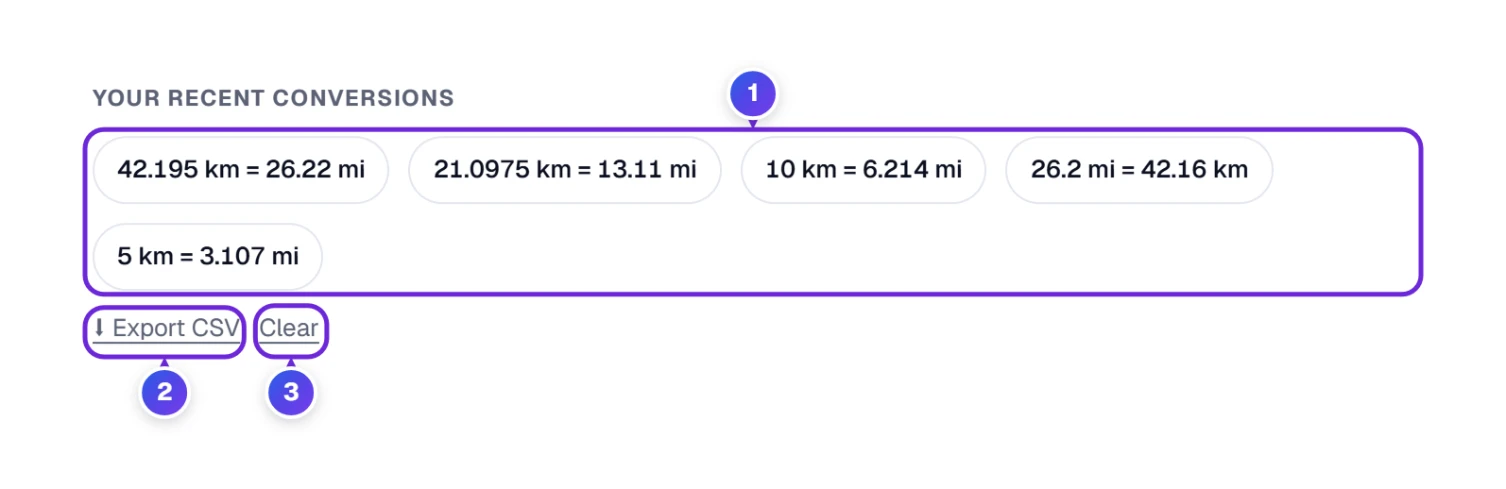
- Pick any entry 1 to load it again. The list shows five, the device keeps twenty.
- ⬇ Export CSV 2 downloads the stored 20 with a date and time on every row, handy as a basic training log. A small progress panel counts it through to “Done!”.
- Clear 3 wipes the list.
Send a Distance to a Friend, or Keep the Converter Handy
Under the converter is a row of buttons for keeping it close and for passing an answer on.
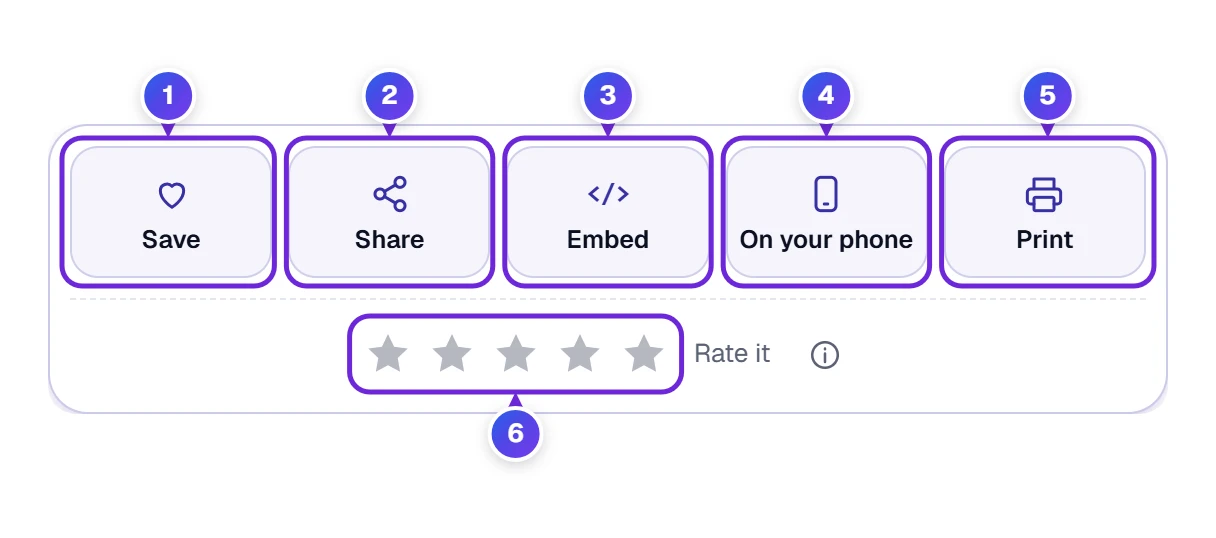
- Save 1 puts the converter in your My Tools list on this device.
- Share 2 opens the window you see in the next picture.
- Embed 3 hands you a short code for putting the converter on a running club’s website or your own blog.
- On your phone 4 turns the page into a QR code. One scan with your camera opens it, ready for the next race.
- Print 5 prints the page, or saves it as a PDF.
- The stars 6 are for rating the tool. Ratings help other visitors judge it.
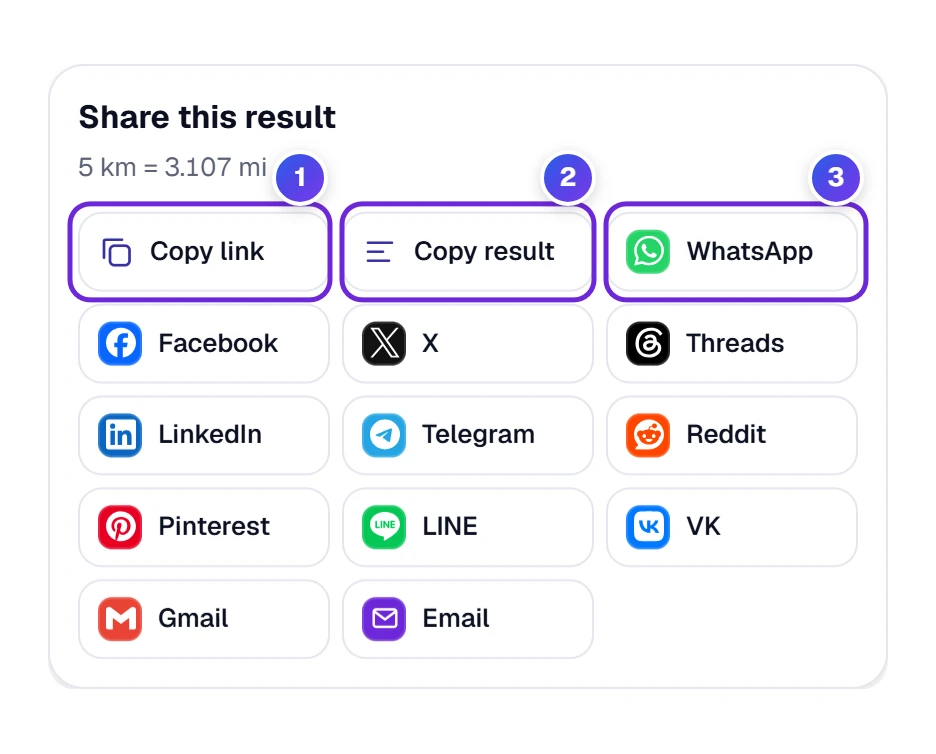
- Copy link 1 hands you an address that brings your exact numbers back.
- Copy result 2 copies the sentence “5 km = 3.107 mi” plus the page address, so a friend lands on the same numbers.
- Or send it straight to an app 3: WhatsApp, Facebook, X or email.
Keyboard Shortcuts on a Computer
Press ? on your keyboard to see every shortcut. They only work when the cursor is not in a box.
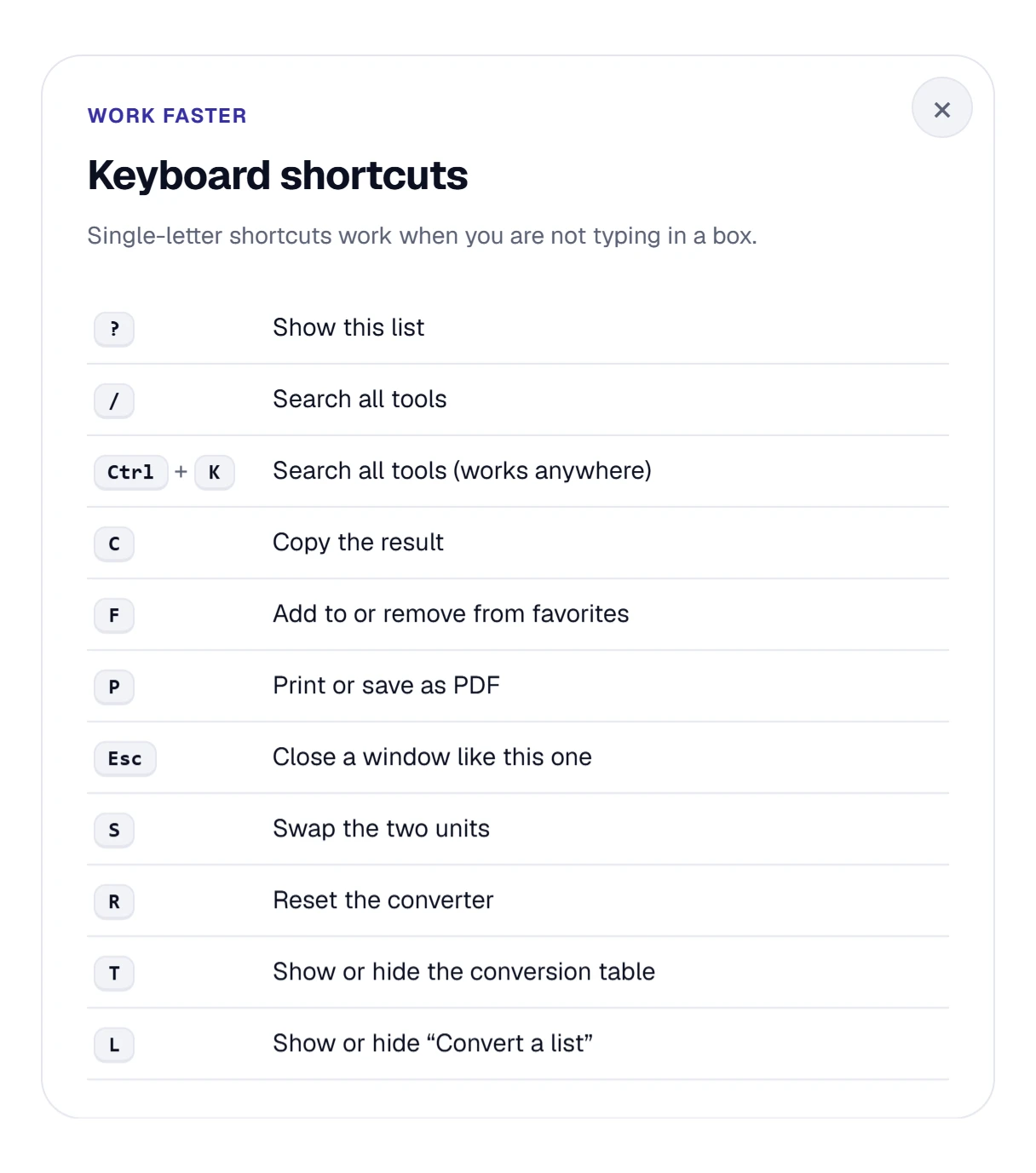
- S swaps kilometers and miles, R resets.
- T toggles the table, L the list.
- C copies the answer line, F pins the tool to My Tools, and P prints the page.
- / or Ctrl + K searches every ToolHa tool; Esc closes any window.
On a Phone at the Track
On a phone the parts stack one under another, the named quick values and the Rounding choices wrap into short rows, and you never scroll sideways. Everything else works as it does on a computer.
Running with your phone in a pocket? Pick “Add to Home screen” from the browser menu, and the converter will open with one tap after the race.
How to Convert Kilometers to Miles
The formula is simple: miles = kilometers × 0.621371. Because one mile is defined as exactly 1,609.344 meters, you can also get the exact answer by dividing: miles = kilometers ÷ 1.609344.
Three worked examples:
- An 8K race: 8 × 0.621371 = 4.971 miles
- A 25 km bike ride: 25 × 0.621371 = 15.5343 miles
- A highway sign in Canada saying 150 km: 150 ÷ 1.609344 = 93.2057 miles, about an hour and a half at 100 km/h
Going the other way? Multiply miles by 1.609344 to get kilometers, or use the Miles → Kilometers button above the answer.
Mental Math for Kilometers
- Multiply by 0.6. It is fast and close enough for a rough idea (about 3.4% too low): 10 km ≈ 6 miles.
- Multiply by 5, then divide by 8. This lands within 1% of the exact answer: 40 km × 5 ÷ 8 = 25 miles (exact: 24.85). We checked the trick against every row of the table below, and it is always about 0.6% high.
- Use Fibonacci numbers (5, 8, 13, 21, 34). Each number in kilometers is roughly the one before it in miles: 8 km ≈ 5 mi, 13 km ≈ 8 mi, 21 km ≈ 13 mi, 34 km ≈ 21 mi.
Kilometers to Miles Table
| Kilometers | Miles |
|---|---|
| 1 km | 0.6214 mi |
| 2 km | 1.2427 mi |
| 3 km | 1.8641 mi |
| 4 km | 2.4855 mi |
| 5 km | 3.1069 mi |
| 6 km | 3.7282 mi |
| 7 km | 4.3496 mi |
| 8 km | 4.971 mi |
| 9 km | 5.5923 mi |
| 10 km | 6.2137 mi |
| 15 km | 9.3206 mi |
| 20 km | 12.4274 mi |
| 25 km | 15.5343 mi |
| 30 km | 18.6411 mi |
| 40 km | 24.8548 mi |
| 50 km | 31.0686 mi |
| 75 km | 46.6028 mi |
| 100 km | 62.1371 mi |
| 200 km | 124.2742 mi |
| 500 km | 310.6856 mi |
Miles to Kilometers Table
| Miles | Kilometers |
|---|---|
| 1 mi | 1.6093 km |
| 2 mi | 3.2187 km |
| 3 mi | 4.828 km |
| 4 mi | 6.4374 km |
| 5 mi | 8.0467 km |
| 6 mi | 9.6561 km |
| 7 mi | 11.2654 km |
| 8 mi | 12.8748 km |
| 9 mi | 14.4841 km |
| 10 mi | 16.0934 km |
| 13.1 mi | 21.0824 km |
| 15 mi | 24.1402 km |
| 20 mi | 32.1869 km |
| 26.2 mi | 42.1648 km |
| 30 mi | 48.2803 km |
| 50 mi | 80.4672 km |
| 100 mi | 160.9344 km |
Running and Race Distances
| Race | Kilometers | Miles |
|---|---|---|
| 5K | 5 km | 3.11 mi |
| 10K | 10 km | 6.21 mi |
| 15K | 15 km | 9.32 mi |
| Half marathon | 21.0975 km | 13.11 mi |
| Marathon | 42.195 km | 26.22 mi |
| 50K ultramarathon | 50 km | 31.07 mi |
| 100K ultramarathon | 100 km | 62.14 mi |
Race courses are measured along the shortest possible route, so your watch will usually show a little more than the official distance. That is why many runners say a marathon is “26.2 miles” even though it is 26.2188.
Driving in Canada or Mexico: Road Signs in Kilometers
Drive north or south of the border and the signs change: distances are in kilometers and speed limits are in kilometers per hour. Many US cars show km/h as small numbers on the speedometer, and rental cars there usually show km/h first.
- Distances: a sign that says 80 km is about 49.7 miles away. Type the number into the converter, or multiply by 0.6 for a quick guess.
- Speed limits: the same factor works for speed: mph = km/h × 0.621371.
- Weather: the forecast over the border is in Celsius as well; our Celsius to Fahrenheit Converter gives you °F.
| Typical road | km/h | mph |
|---|---|---|
| School zone or town | 30 km/h | 18.6 mph |
| City street | 50 km/h | 31.1 mph |
| Rural road | 80 km/h | 49.7 mph |
| Highway | 100 km/h | 62.1 mph |
| Fast highway | 110 km/h | 68.4 mph |
Kilometer vs Mile: What Is the Difference?
A kilometer is 1,000 meters, the metric (SI) unit of length used by almost every country. The meter itself is defined by the speed of light, so it is the same everywhere.
A mile (the statute or international mile) is 1,760 yards or 5,280 feet. Since the international yard and pound agreement of 1959, a yard is exactly 0.9144 meters, which makes one mile exactly 1,609.344 meters. A mile is therefore about 1.61 times as long as a kilometer. The same agreement fixed the pound at exactly 0.45359237 kilograms, the value our KG to Pounds Converter uses.
The United States and the United Kingdom still use miles for road distances and speed limits (mph). Nearly every other country uses kilometers and km/h.
Easy Mistakes With Miles and Kilometers
- Mixing up miles and nautical miles. A nautical mile, used at sea and in aviation, is exactly 1.852 km (about 1.15 miles), so it is a different unit.
- Rounding too early. Using 0.6 instead of 0.621371 makes a 100 km trip about 2.1 miles too short. Round only at the end.
- Using the old US survey mile. It was 1,609.347 m and was retired at the end of 2022; today every mile is the international mile.
- Swapping the factor. Multiply km by 0.621 to get miles; multiply miles by 1.609 to get km. Never the other way around.
Who Needs Kilometers in Miles?
- Runners turn 5K, 10K and marathon distances into miles, check their pace per mile and paste race splits into Convert a list.
- Travelers and drivers heading to Canada, Mexico or Europe read road signs and speed limits in miles.
- Students check homework with Explain this result, which shows every step of the math.
- Cyclists and hikers convert trail maps and bike computers set to kilometers.
- Car buyers check an odometer in kilometers: 100,000 km is about 62,137 miles.
What Stays on Your Device
- Your recent conversions and favorites are remembered on this device; Clear removes the conversions.
- A shared link contains only the number and the two units, for example ?v=5&from=km&to=mile.
Answers That Look Wrong, and Why
- The answer looks rounded. A fixed number of decimals is selected under Rounding. Switch back to Automatic, choose more decimals (up to 6), or press Reset.
- Nothing changes when I type. The box only takes numbers. Use a dot for decimals (5.5), not a comma.
- A line in Convert a list says “not a number”, or one line became two. The first means the line has no number in it. The second happens when you write a decimal with a comma, like 5,5. Use a dot instead.
- Yesterday’s conversions are missing. The history lives on this device, so a private window, another browser or cleared browsing data starts with an empty list.
- The link I shared opens with 1 km. Type your number first, then use Share → Copy link; the link carries the number you see.
Kilometers and Miles: Quick Answers
How Many Miles Is 1 km?
1 kilometer is 0.621371 miles: a little over six-tenths of a mile, or about 1,093.6 yards.
How Many Kilometers Are in a Mile?
Exactly 1.609344 kilometers. This value has been fixed by international agreement since 1959.
How Far Is a 5K in Miles?
A 5K is 5 kilometers, which is 3.11 miles, usually rounded to 3.1 miles.
How Many Miles Is a 10K?
A 10K is 10 kilometers, which is 6.21 miles, usually rounded to 6.2 miles. Tap 10K in the quick values and the converter fills it in for you.
How Many Miles Is a Marathon?
A marathon is 42.195 km, which is 26.22 miles (usually written as 26.2). A half marathon is 21.0975 km, or 13.11 miles.
How Long Does It Take to Walk 1 km?
About 12 minutes at a normal walking speed of 5 km/h (about 3.1 mph). A mile takes about 19 minutes at the same speed.
Can I Convert a List of Kilometers to Miles at Once?
Yes. Open Convert a list under the tool, paste your values one per line, and copy the answers or download them as a CSV file. It takes up to 500 values at a time.
Can I Round Kilometers to Miles to a Whole Number?
Yes. Pick Whole number in the Rounding choices under the quick values, and a marathon of 42.195 km shows as 26 miles. You can also choose 1, 2, 3, 4 or 6 decimals, and Reset puts the converter back on Automatic.